Welcome to Part 0 of our Starbased Manual! This first, optional part of our manual is really a short intro to Starbased, the next step (Fleet Command), and the rough timeline of events that led to its creation. That last part, though the longest, is really only for the OG community members who like to reminisce a bit or for new players who are curious or like to understand what others are talking about.
In the next part of this series, we’ll get into the actual gameplay, so feel free to skip all of this if you simply want to get in ASAP and already know what Starbased is or just don’t care. However, starting here is very much recommended if you are new to Star Atlas (though feel free to skip the History chapter)!
SAGE Starbased – Play now!
What is Starbased?
Starbased is an online, on-chain, 2D, top-down economic game set 6 centuries into the future in a region of space called the Galia Expanse.
In it, you create fleets of ships that you send out to mine, scan, and transport resources. In addition, you task crew members with crafting various items and compounds using resources you mined or acquired. You can sell your crafts on the marketplace to other players, or you can choose to contribute those to your Faction to boost their presence within a star system.
Calling it an MMO may be a stretch, although it is a multiplayer game that has the capacity to scale to millions of players (or, well, that is the intent). It also persists state. Actions taken are not forgotten when you close the game or log off. In fact, your fleets will continue following your instructions for as long as they can. In addition, actions taken are observable by everyone and sometimes may affect other players.
If you hope to find a full 4X game (Explore, Expand, Exploit, Exterminate), then realize that Starbased is not that just yet. Though SAGE is to become a true 4X game, at this point in time, really only Exploit (players gather and use resources in areas their Faction controls and improve the efficiency of that usage) is available in-game.
Getting Started
You will need ships to play the game, which you can acquire at the Galactic Marketplace, the name for Star Atlas’ home-built asset market.
Which ship(s) to buy is a question for another time, and the answer will vary greatly on what you want to achieve in-game. It’s probably best to ask for advice on the Star Atlas Discord. Alternatively, you could consider joining a guild (DAC), such as one that is known for publishing guides to help new players *wink, wink*.
When you have a ship (or ships), you can head over to based.staratlas.com to enter the game. Make sure to check the next part of this manual (to be released soon; see our anniversary schedule) to get up to speed quickly!
If you want to learn more about the game and the ecosystem in which it lives, read on!
What is in a Name?
You will often see many different terms used to describe the browser game on Discord and in interviews, community content, tweets, and articles. Let’s try to shed some light on these here before we continue!
SAGE – Star Atlas Golden Era – The mini-game project that is to be a mini Star Atlas SAGE Labs – The first & current version of SAGE, which is 2D and temporary Starbased – The current version/iteration of SAGE Labs. You can compare this with the first significant update/DLC for SAGE Labs.
In effect, all three terms are used interchangeably to refer to the current iteration of the mini-game. We’ll primarily use Starbased throughout the various parts of this manual unless we want to refer to the game itself instead of the current iteration, in which case we use SAGE.
Curious about where Fleet Command comes in? Want to know why there is a Star Atlas and a Star Atlas Golden Era? Read on!
Star Atlas and its Golden Era
In January 2021, ATMTA’s co-founders published the White Paper for a wildly ambitious game/metaverse called Star Atlas. They had been working on polishing their ideas during the months prior and decided it was ready to share their brainchild with the world and start building. The White Paper outlines the core game experience that the team wants to deliver: a M_assively Multiplayer Online Grand Strategy Role-Playing Game_ set in space and built on the blockchain. And that really only describes a small part of it, as the goal is to evolve the game into a metaverse (portal). In short, Star Atlas is a very ambitious project, perhaps the most ambitious gaming project ever conceived.
Realizing that accomplishing their vision would take many years, the founders envisioned a parallel development track where they would build and deliver a browser mini-game. They felt this was important to keep their community (which they hoped to build) engaged and provide them with a way to utilize their on-chain assets. After all, the plan was to crowd-fund the company through asset sales (primarily ships) and an IDO (ATLAS & POLIS), and they needed to get something out sooner rather than later to ensure that those assets would have a use (gameplay, yield, or preferably both).
Over the course of 2021, creating the UE5 development pipelines went slow but steady (as expected), but the team struggled tremendously with the mini-game. In our History section, we go deeper into some of this, but the relevant part is that in March and May of 2022, the team decided to take a different approach. Instead of creating a temporary mini-game, they would take the essence of their flagship UE5 game and create a trimmed-down version for the browser. It would also not be a 2D game, instead they would use a WebGL framework called PlayCanvas to bring this to us in 3D!
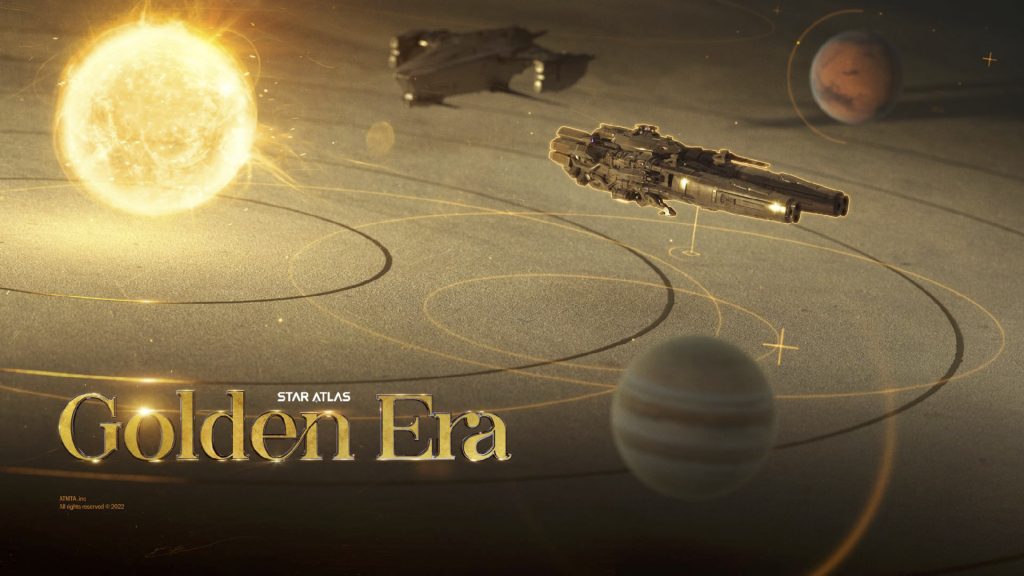
Star Atlas Golden Era (SAGE)
The name of this game? Star Atlas Golden Era, or SAGE for short. The team has been working on this project ever since.
Did this decision mean that the development of the browser game could finally get on track and speed up? Not exactly. The struggles continued, but development efforts eventually culminated in the release of SAGE Labs in September of 2023.
Now, this version of SAGE was different from the product that the team originally envisioned. PlayCanvas turned out to be a huge headache, which caused the project to keep slipping. At one point, the team decided to spend a few weeks polishing their internal 2D testing tool and releasing it instead. This version of the game was introduced as SAGE Labs. This was not the end product the team had envisioned 15 months prior, though it did offer mining, scanning, and crafting loops and finally unlocked the economy through a game. However, it was only meant to provide a temporary user interface until the 3D version went live. That 3D version is a story in itself, discussed further below in the History section. In the end, the version we are playing today is a much more polished version of SAGE Labs and, therefore, is still in 2D.
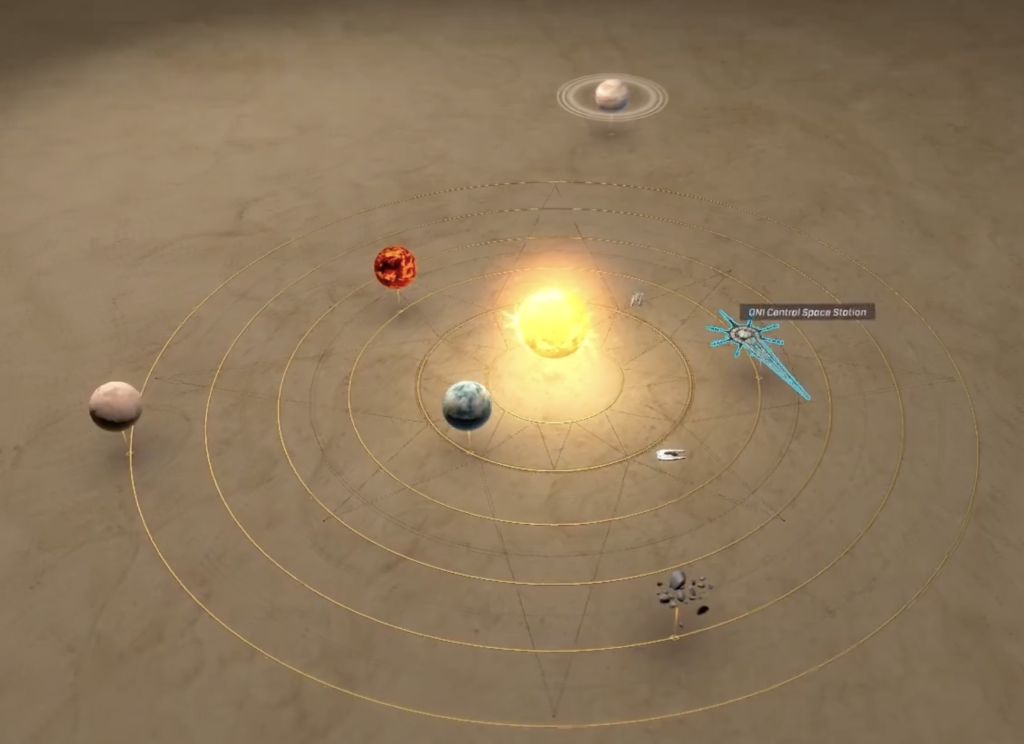
SAGE 3D [Early footage]
Fleet Command
The team’s original goal for SAGE was to natively render a beautiful 3D game in your web browser, utilizing WebGL through a framework called PlayCanvas. The team even briefly launched that version, dubbed SAGE 3D, but it was obsolete almost as soon as they did (see below for more). On the day of its unveiling, it lacked some of the features SAGE Labs had picked up in the meantime.
However, a bigger problem was the poor performance and the team’s constant struggle with scalability issues. Ultimately, this led them to abandon the development of an in-browser 3D version of SAGE.
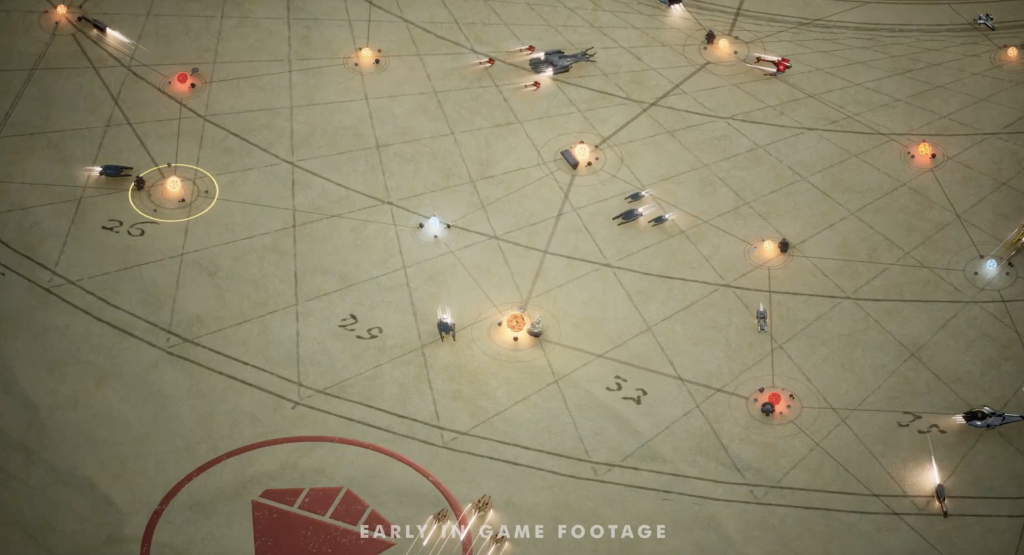
Fleet Command [As presented during Solana Crossroads – Istanbul – May 2024]
Enter Fleet Command! Seeking alternatives, they found no suitable replacement for PlayCanvas, which led them to conclude WebGL was not a viable path going forward, for now. Instead, they asked themselves, why not build this into their Unreal Engine product?
Though this would mean no access on smartphones or tablets out of the gate, intense optimization after the initial rollout should make it possible to split it off into a stand-alone version that would run on such devices later on. Additionally, pixel streaming solutions are also progressing and could provide an alternative path to solve this problem.
In the short term, however, it would provide PC players with a 3D version of SAGE with a graphical fidelity that blows SAGE 3D clean out of the water!
In addition, there are some great benefits to the team as well! As we’ll explore in the History section below, the decision to develop SAGE for the browser allowed the team to synergize the blockchain development (back-end) efforts with their (future) UE5 game. With Fleet Command running in UE5, the front-end development efforts would also profit from significant overlap!
Not only can they reuse all 3D assets [Red: custom low-poly variants were needed for SAGE 3D], but the actual gameplay of commanding fleets and jumping in them in first-person to take control is identical to the core gameplay that is planned for the UE5 flagship game!
History
Now, let’s dive deeper into how we got from the White Paper to SAGE Labs today!
The White Paper the founders published at the start of 2021 mentions a Browser Mini Game. It’s somewhat vaguely defined as a Minimum Viable Product version of Star Atlas in the form of a browser-based minigame. Its primary goal is to ensure that players and collectors will immediately be able to utilize the in-game assets they acquired while also providing an option to buy more assets.
During the many interviews and Town Halls with Michael Wagner (CEO) in 2021, additional color was provided. The goal was to launch a mission-based, 2D, on-chain experience comprised mostly of text and static visuals. In the first version, ships would be sent on missions into deep space and return with various spoils, such as ATLAS, NFTs, and Crew members. In the next iteration, mining through claim stakes would be introduced. The goal was to launch the first version in Q3 of 2021, with the end of August being one of the earliest suggestions.
SCORE
To make a long story short, that did not come to fruition. Instead, on December 16th of 2021, the team launched project SCORE (Ship Commissions on Remote Expeditions), officially named Faction Fleet, which was an on-chain service where asset owners could stake their ships and get ATLAS rewarded for as long as they kept them supplied with Food, Fuel, Ammunition, and Toolkits (often referred to with R4–as these were the first four resources ever to be introduced to the game). Faction Fleet is still live today, although its earnings are roughly 33% of what they were at inception, to encourage a migration to the active gameplay of SAGE.
MORE CREAM
When the team released SCORE, they dubbed it SCORE – Tier 0, signaling that this was just the beginning and more updates would follow. Originally, SCORE – Tier 0 was not meant to last for more than 6 months. The team had plans to launch SCORE – Tier 1 around mid-2022, which would supersede it, introducing a lot more depth and a clear mission structure to this game mode. The core idea was that players would have to interact with mission-givers, accept the mission, compose the best possible fleet for it, and send it away for a certain amount of time. The fleet composition would play a big factor in whether or not the missions would be completed successfully.
In parallel, the team would work on MORE, introducing a similar staking mechanic as SCORE did but focused on Mining with the Claim Stake assets.
Then, in early 2022, the team announced that they would focus instead on a completely new project, superseding both SCORE and MORE, dubbed CREAM. This new project’s goal was to deliver more gameplay on top of staking assets, with the gameplay being summarized as:
- mining & extraction
- crafting & materials
- space exploration
The plan was to release CREAM in July of 2022.
SCREAM
Then, in March of 2022, the team pivoted completely and decided to toss all of their plans out of the window. Instead, they would put their resources towards building a bigger, better game for the browser. It would be a 3D game that would align closely to their plans for the full Unreal Engine 5 game. Of course they had a great new acronym for this project: SCREAM! This stands for Ship Configuration, Resource Extraction, And [Ship] Missions.
In May, the team tweaked these plans, postponing Ship Configuration and shifting their focus from Missions to the Grand Strategy gameplay that is also planned for the UE5 game. Keeping the SCREAM acronym, they creatively updated its meaning to Ship Combat, Resource Extraction, and Manufacturing.
May 2022 marked the last time the team overhauled their plans for the mini-game. Their reasons for this final change were pretty solid. This would:
- Allow them to develop blockchain programs they could reuse in their flagship product. Instead of creating on-chain programs (smart contracts) for a short-lived game, the team would be creating programs that would be used by their UE5 game as well, saving time and effort.
- Give them a long R&D period, allowing them to iterate on and experiment with their on-chain programs before finalizing them for the UE5 implementation. Michael often mentioned they were doing a lot of pioneering work, as no one had done any of this before.
- Level up the experience from a text-based browser game to something that would be much more closely related to their flagship product and that would not be temporary, but persist in parallel to the flagship product.
- Share the on-chain game state with UE5 (in the future). Actions taken in SCREAM would directly influence UE5 in real time and vice versa.
In June of 2022, the team showed off some early experiments, shown in the video below:
SAGE
In November of 2022, during the Solana Breakpoint conference, the team revealed the official name for project SCREAM: Star Atlas Golden Era, or SAGE for short. Shortly after, the team shared that SAGE was pushed back a bit and would likely be watered down somewhat, for starters. The team also released the first iteration of the Game manual for SAGE around that time.
In early 2023, we learned that the 3D front end had not been coming along the way the team had hoped. They decided to break down the first iteration of SAGE further into three smaller iterative releases:
- Movement – This became Escape Velocity, which was essentially a movement/stress test with some prizes. It was launched on April 26th, 2023, and sunset on July 7th, 2023.
- Resource Extraction & Crafting – Also known as SAGE: REC. This would add basically everything we have in the current game, though, without the many iterations that have gone over it since.
- Combat – This was to be the third module, adding combat to SAGE.
Note that all these were supposed to be in 3D, and Escape Velocity was, in fact, a 3D game/test.
In mid-July 2023, the team announced the official name for the next iteration of SAGE. What we had come to know as SAGE: REC would henceforth be known as SAGE Starbased.
In August 2023, it became clear that the team would not be able to release SAGE Starbased the way they wanted. Creating the 3D interface using PlayCanvas (WebGL) turned out to be more difficult than the team anticipated. Hooking it up to StarComm (the middle layer) did not go nearly as smoothly as the team had hoped.
SAGE Labs
That is when the team decided to polish up their internal 2D testing tool and publish it under the name SAGE Labs. It took them a few weeks, but they launched the first version of this game on September 23rd. This marked a tremendous occasion, as the player economy was now finally live!
SAGE 3D Promo Image
SAGE 3D
In December, the team finally launched the 3D version of SAGE! The team noted that this was not the Starbased release just yet, as it lacked some of the forthcoming Starbase-related gameplay.
Unfortunately, the 3D interface did not yet have all the quality-of-life improvements that SAGE Labs had received. It also turned out to be a memory hog for many players, resulting in a sluggish feeling gameplay experience. Players tried it out, but most returned quickly to the 2D interface of SAGE Labs.
What likely really sealed its fate for most community members was that mere days after the 3D game launched, the team released several major improvements to SAGE Labs’ 2D interface.
SAGE Labs: Starbased
Instead of frantically working to bring the 3D interface up to snuff, the team admitted defeat and instead focused on the 2D interface. On April 4th, 2024, they finally brought the much-anticipated Starbase upgrading features and other improvements online in the SAGE Labs Starbased release!
This is where we are now! Having learned from the SAGE 3D release, the team has invoked a feature freeze on SAGE Labs to allow their team to bring Fleet Command up to the same level of gameplay and reach feature parity between the two versions of the game.
From there, the team can really go in multiple ways! We’ll have to wait and see what the team plans for us next!