z.ink is a new layer 1 (L1) blockchain that will be launched in December 2025. It was conceived by ATMTA, the studio behind Star Atlas. It uses the Solana Virtual Machine (SVM), which also powers Solana’s high-performance blockchain, enabling smart contract execution with speed and efficiency.
Unlike most other non-Solana SVM-based chains, it aims to adhere to the example set established by Solana. In fact, it is trying to be as close a copy of Solana as possible. This will allow Solana developers to seamlessly deploy their programs to z.ink (once ATMTA opens up the network).
As it is built by ATMTA, z.ink will function as an independent entity operating as a fully owned subsidiary under ATMTA. The team is raising capital to hire a separate team that will focus on growing the ecosystem, developing new features, and maintaining the network. At the moment, understandably, there is some engineering crossover, but the goal is to ensure the current team can remain fully focused on Star Atlas.
Note: The article below contains information from the recent Town Hall, plus clarifications posted in the past few days on Discord. It has been written with the Star Atlas community in mind, not investors.
What Makes z.ink Unique
At first glance, there is nothing unique about z.ink from a technical perspective. It appears to be completely identical to Solana.
However, the team is doing a few interesting things that haven’t been done before!
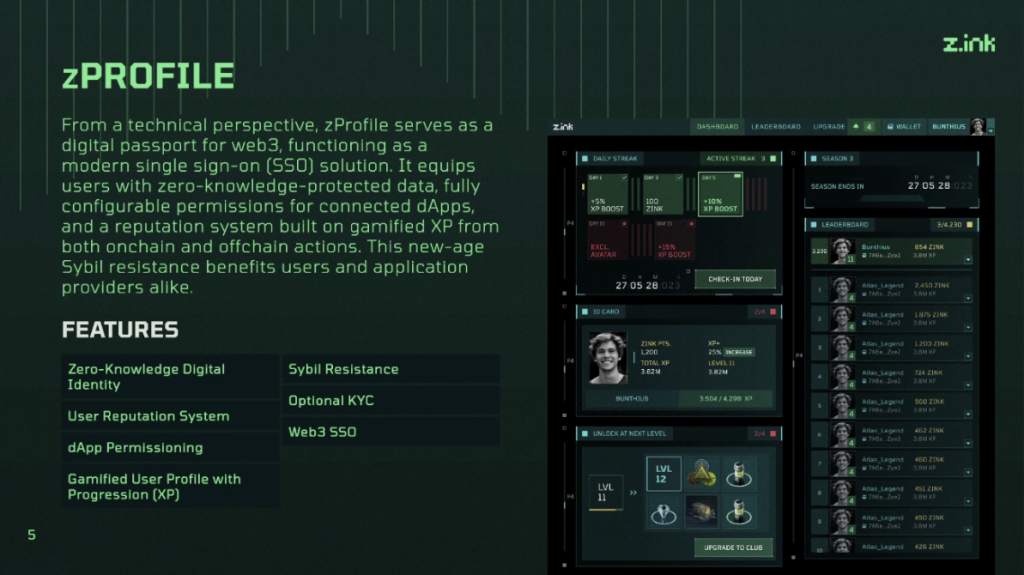
z.ink — zProfile
zProfile
They are launching a profile service, dubbed zProfile. This is leveraging ZK technology to keep your data private and is built on the same PlayerProfile technology that Star Atlas is using nowadays.
Essentially, the team positions this as a digital passport, which allows you to authenticate yourself with other services through a Web3 version of the Single Sign-On (SSO) process (think Login with Google/Facebook, but now Z.ink).
This comes with a number of strong benefits:
- dApp Permissioning — You can assign permission to your wallets for each on-chain service you are using. This means that you set limits on what certain services can do automatically (without needing to sign additional transactions). This works much like SAGE does with Atlas Prime, and automation services like SLY Assistant and Atom.
- Optional KYC — If you want, you could complete your own KYC. This, however, does not do anything directly. Other services, however, would no longer need to run their own KYC. Instead, they can securely verify that you have already completed KYC with the network before. This is a binary process where the service would not get access to your data. In short, KYC once and never again on z.ink. Of course, this being optional, you can stay away from it.
- Gamification — It gamifies on-chain activity by rewarding you with XP and allowing you to level up. This is interesting for a couple of reasons. One is that this will tie directly into the airdrop campaign. The more XP, the higher your airdrop.
Combined, the zProfile enables other services seeking to airdrop to OGs or active users to do so simply by checking these profiles. In fact, they can go so far as to reward people who have reached a certain level, completed KYC to ensure these are real and unique people, and have been active on a specific service. All of this is readily available from day 1.
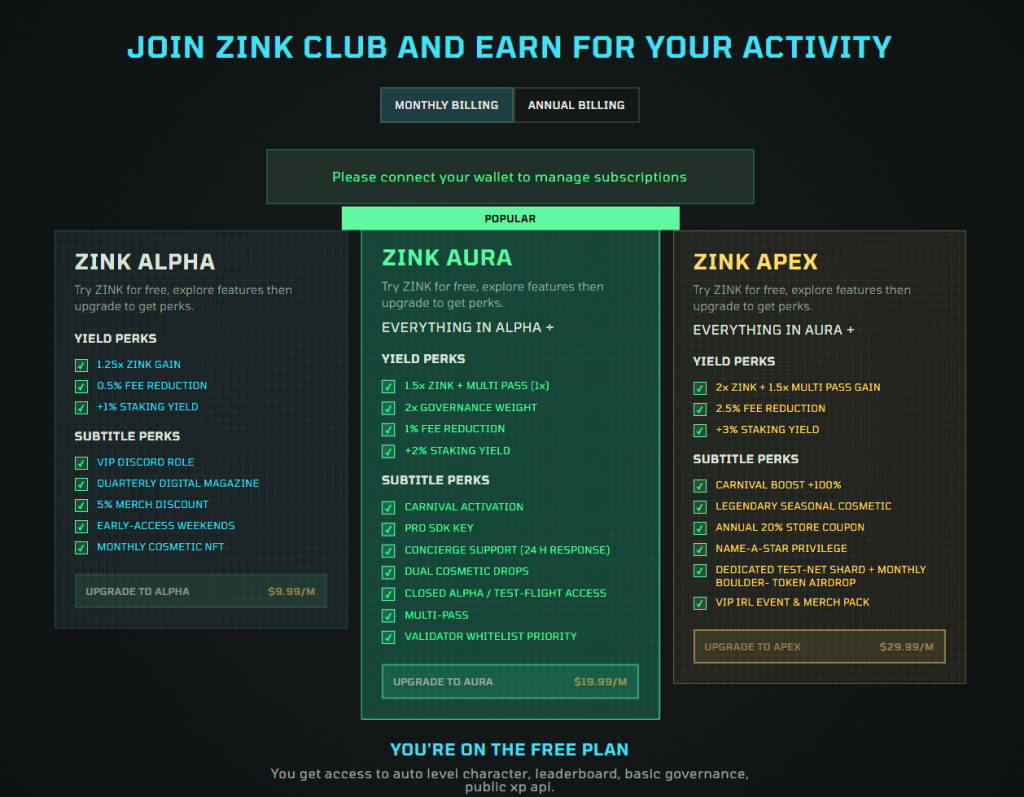
Zink Club – Subscription – This contains placeholder benefits!
Subscription Service
They are launching a subscription service akin to battle passes in games. You will unlock various benefits through this subscription, which has 3 tiers with increasing benefits.
On top, they are themselves creating a naming service (.ink). These will likely not be sold separately, but will be part of the subscription rewards.
One other benefit is that a subscription will increase your XP earning rate. On top of that, the team is planning to reward you with certain Star Atlas assets at specific levels if you have a subscription.
Subscriptions will go live when the first airdrop season starts (see below).
And more…
Not headline items, but the team will make the primitives they developed for Star Atlas available on Z.ink for developers to use, including:
- Foundation Kit — Add SVM support to your UE5 game
- Starframe — An upgrade of Anchor that allows for more complex programs, less compute, and fewer transactions
Mutual Benefits
Star Atlas should benefit from this, of course. That is why the team came up with this solution. But this actually goes both ways. There is a nice synergy between z.ink and Star Atlas.
z.ink benefits for Star Atlas
What benefits does z.ink bring to Star Atlas?
- Lower fee costs — The team expects the fees to be at least 99% lower at launch.
- Improved stability — with only Star Atlas operating on the chain, plus potentially a smattering of DeFi services, there should be no congestion at all. Also, the smaller number of validators will make the chain significantly faster from the get-go.
Lower fees are not only relevant to the players, by the way. Brett (VP of Engineering) shared that deploying C4 on Solana would have cost ATMTA around 200 SOL, or $40k, to get game systems online. On z.ink, that will essentially be free.
Though the above benefits are crucial, and are what led the team to launch this chain, that is not all!
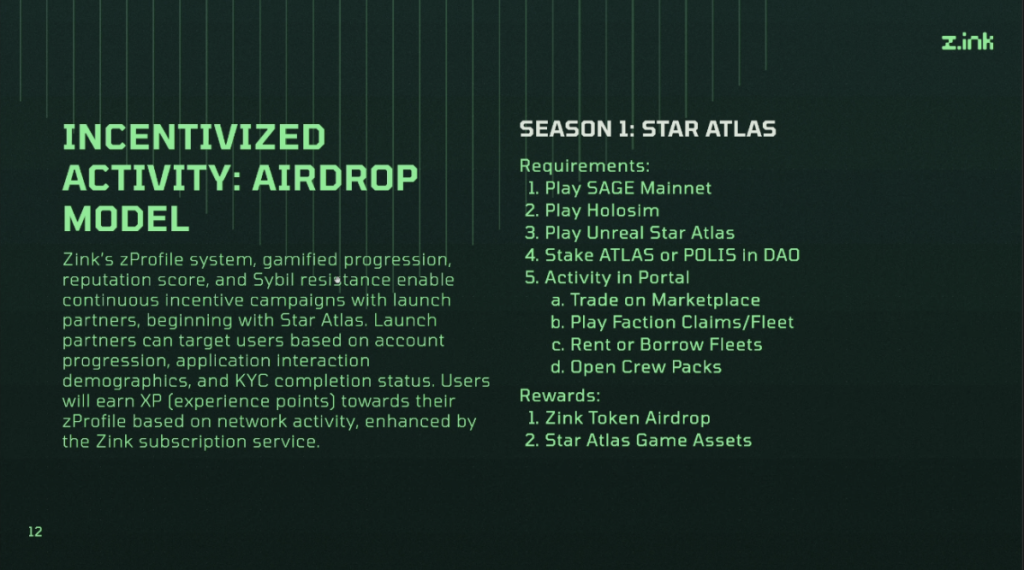
z.ink — Airdrop Campaign
Airdrop Campaign
Being a brand new blockchain, a big part of the marketing strategy (and to seed the initial tokens) is to airdrop tokens as part of an extensive incentive campaign.
The campaign will be divided into seasons, with the first one taking place before the network is even live, from September to December (running a little over 3 months). The team plans to host at least 4 seasons of airdrops over 2 years.
The way to qualify for an airdrop and earn a bigger allocation is by gaining XP on your zProfile, the chain’s native PlayerProfile implementation.
For the first season, there will only be one way to earn this XP: participate in the Star Atlas ecosystem. Specifically, the following activities will be rewarded:
- Buying assets from the team on the Galactic Marketplace (aka: primary asset sales)
- Locking ATLAS in the Atlas Locker
- Locking POLIS in the Polis Locker (this will be directly tied to total Polis Voting Power)
- Playing SAGE (including C4 on PTR)
- Playing Holosim
- Earning XP in UE5
- Renting & Borrowing fleets in SAGE
- Playing Faction Fleet & Faction Claims (locking and maintaining)
- Opening Crew Packs
In other words, you’d have to play the game or lock tokens to qualify for the airdrop and to get a bigger allocation. Michael shared that SAGE mainnet activity will get a higher weighting than Holosim & UE5, as those can be played for free.
Note: previous activity is disregarded. Everyone starts from scratch the moment season 1 of the campaign launches in September. For those wondering why, Michael shared:
[…] the purpose of the airdrop is to grow the ecosystem. If all the SA OGs just get 99% of the benefits, no one will want to join.
Airdrop Rewards
The team plans to airdrop 30-40% of the total supply across the various seasons. This first season alone will airdrop 10% of the total supply. For this first season, the team also plans to reward participants with Star Atlas assets on top!
Note that to be eligible for the airdrop rewards, you do need a zProfile with all your relevant wallets attached to it. You will be able to do this closer to the start of the campaign. Michael shared that ATMTA will not create a zProfile for their own POLIS Locker account, so that one will not compete with the players for the Polis Locker-related allocation.
Increased Runway
Perhaps this is only an indirect benefit for Star Atlas Players, but we figured it makes sense to mention it here as well. After all, as ATMTA’s runway increases, their chances of accomplishing their ambition over the next few years grow. Additionally, if they could scale their team up, we would get more features and receive them sooner.
z.ink has the potential to put money into ATMTA’s coffers. To some extent, this is money from the existing community, but the above clearly demonstrates the team is trying to grow the pie and attract more daily active users.
Star Atlas Benefits for z.ink
But the benefits go both ways. z.ink is also benefiting from Star Atlas. Every new chain has to figure out the cold start problem. You’d want to onboard many users, but they will only do so when there are things to do. And you’d want developers, but they won’t build if there are no users. It’s a classic chicken-and-egg problem.
Z.ink solves this problem handily by launching with Star Atlas, which brings a few thousand users to the chain and generates a considerable amount of transactions (although less relevant, this makes the chain appear very active, which is appealing).
A New Token: Zink
A new token is required because the team requires a substantial amount of tokens:
- for the marketing campaign, grants, and private sales, and
- to incentivize and align a new team dedicated to maintaining and extending z.ink, and
- to decentralize the network through validator incentives and staking rewards
Without those bags, the team would:
- have to take a significant chunk of allocation out of the player rewards and game/governance emissions for ATLAS and/or POLIS, or
- have to mint additional tokens, which would cause severe inflation, or
- accept the risk that they fail to clear the launchpad
It would have been great if the existing tokens could have been integrated into the chain, but the above made clear that this was not possible.
That said, the DAO will get a 5% allocation of the total initial z.ink supply, significantly boosting its treasury.
In addition, the DAO will also get access to a validator, which will reward it with additional z.ink from the incentives and fees (though some will likely go to stakers as well, more details to follow).
Roadmap
The roadmap consists of three phases during which features will roll out and the network will decentralize. These are specified as follows:
Phase 1 (starts December 2025)
- Limited validator set (ATMTA + DAO — Note that this could change)
- Seamless bridge with Solana
- All Star Atlas on-chain game systems migrate to z.ink
- Exclusive partner integrations
Phase 2
- Permission expansion (and decentralization) of the validator set
- Expansion of ecosystem with emphasis on fully on-chain game partners
Phase 3 (~2027)
- Full open access and permission-less deployments
- Open access for new Validators
- zProfile support for additional blockchains
Validators
Validators will be rewarded with zink tokens that will be created on top of the Total supply. In other words, through additional minting of zink tokens, which causes inflation. This inflation will start high at 12%, and is reduced year by year (by 20.1%), over 8 years, until it reaches 2%. From then on, it will remain at 2%.
This approach is slightly more aggressive than Solana’s. The inflation starts higher, but is reduced faster (taking 8 years instead of 13), to arrive at the same 2% Solana is using. Starting higher is designed to absorb more of the sell pressure coming from the airdrop campaigns, as staking z.ink will ensure you will receive a cut of the inflation rewards.
Note that these percentages apply to the circulating supply, not to the total supply. So year 1 will not see 12M new zink being created (12% of 100M), but much less, depending on the circulating supply. Michael shared that he estimates 40-60M will be in circulating supply on day 1, of which 10% is coming from the first airdrop season, and the remaining chunk will mostly be locked (staked) into validators.
Here is the full breakdown of the Inflation Rate over the years:
| Year | Inflation Rate |
|---|---|
| 0 | 12.0000% |
| 1 | 9.5880% |
| 2 | 7.6608% |
| 3 | 6.1210% |
| 4 | 4.8907% |
| 5 | 3.9076% |
| 6 | 3.1222% |
| 7 | 2.4946% |
| 8+ | 2.0000% |
z.ink — Network Subsidy Inflation
DAO Validator
The Star Atlas DAO will be operating a single z.ink validator from day 1. Or, at least on paper. ATMTA will technically operate the node, but the DAO will receive all its revenue. Note that the 5% token allocation the DAO receives (see next section) will be staked on this validator.
This is the go-to validator for the community to stake their zink.
Tokenomics
ATMTA shared the following table with regard to their initial z.ink token allocation:
| Name | Allocation % |
|---|---|
| Airdrops + Grants + Partnerships (Ecosystem growth) | 65% |
| ATMTA Team | 20% |
| z.ink Team | 10% |
| Star Atlas DAO | 5% |
z.ink — Token Allocation
A few notes:
- 10% of the supply is earmarked for the first airdrop campaign.
- Michael expects that 30-40% of the supply will be airdropped in total (through various campaigns)
That is all we have for now! Stay tuned for the Atlas Brew this Wednesday, August 21st! We’ll update this guide afterwards with all the new information.
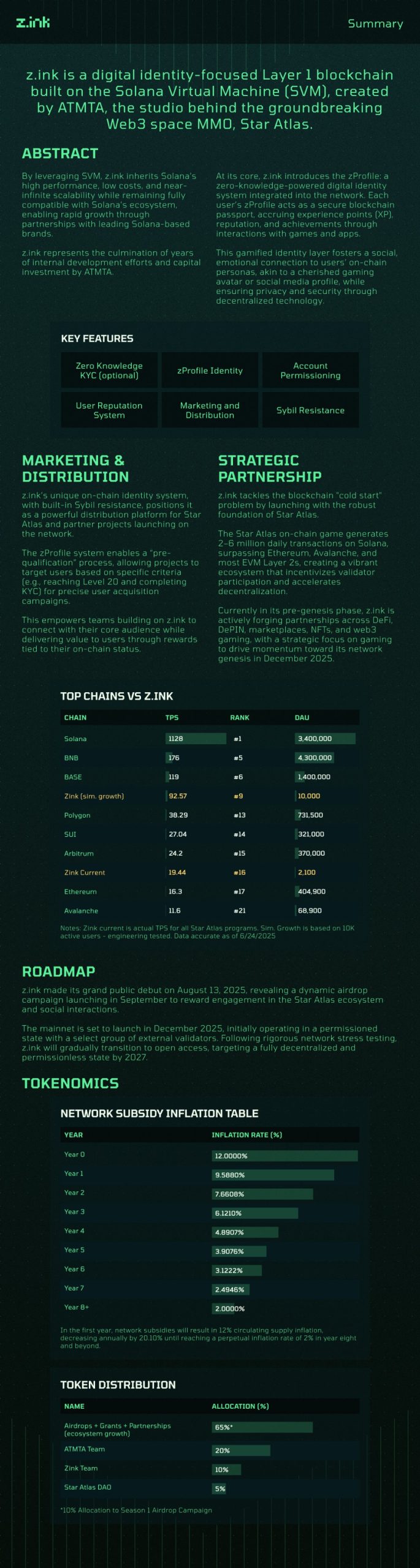
z.ink – One-pager