Welcome to our 162nd newsletter on Star Atlas! This weekly newsletter, published by Aephia Industries, focuses entirely on the development of this ambitious game. Here, we try to aggregate all the newsworthy tidbits revealed [mainly by the team] throughout the past week.
Welcome to the first newsletter of 2025! This Wednesday marks a significant milestone: the fourth anniversary of the Star Atlas White Paper & public unveiling! On this day, the co-founders introduced Star Atlas to the world through an article that celebrated their choice for the Solana blockchain.
The team has returned from the holidays and wasted no time getting back to work. While they’ve been busy squashing bugs, the highlight of the week was a statement from Michael (CEO). In his update, he addressed the ongoing challenges with SAGE on Solana and shared his thoughts on—and preferred solution to—shielding the game from future Solana disturbances.
Meanwhile, the Golden Carnival continued uninterrupted through the holiday season, with three more drawings taking place over the past weeks. And just before Christmas, there was a surprise drop of the long-awaited Ship Part bundles, bringing an extra bit of holiday cheer to the Star Atlas players!
Without further ado, let’s dive in!
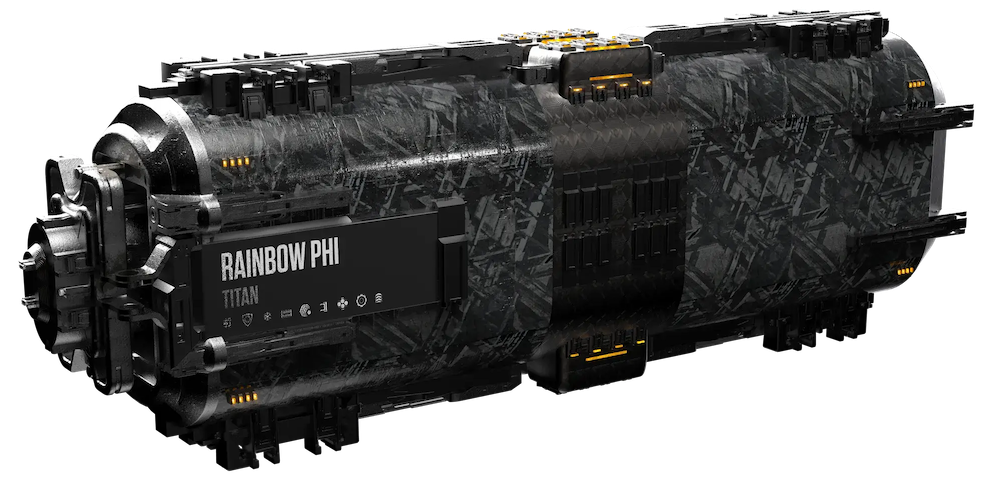
Star Atlas – Rainbow Phi Ship Parts Bundle
Ship Part Bundles Dropped!
Over Christmas, the team—without any prior hint or announcement—dropped the Ship Part bundles, which they originally had planned to distribute on August 9th, 2024.
The Journey Here
For those who lost track, let’s jump back in history for a bit!
The team took a snapshot of all ships (in wallets or any Star Atlas program such as the Marketplace, SAGE, and Faction Fleet) on August 8th, 2024. The goal was to airdrop Crew Packs for every crew member required to man a ship and all the Ship Part bundles (dubbed “Ship Component” bundles back then) the next day, August 9th.
Unfortunately, airdropping 1.2 million Crew Packs (Claims) proved challenging. This caused a three-day delay, and the Packs were finally dropped on August 12th instead.
Due to this struggle, the team decided to postpone the Ship Parts drop, though they stressed there would not be another snapshot. They did not provide a new date for when this drop would take place. Unlike Crew Packs, there was no scheduled gameplay going live that relied on these Ship Parts. As such, most people did not seem to care too much about a delay.
Apparently, the team decided that Christmas would be a great time to drop these bundles, most likely as a Christmas present to everyone, but perhaps also because blockchain activity (like most activities) tends to be less on those days.
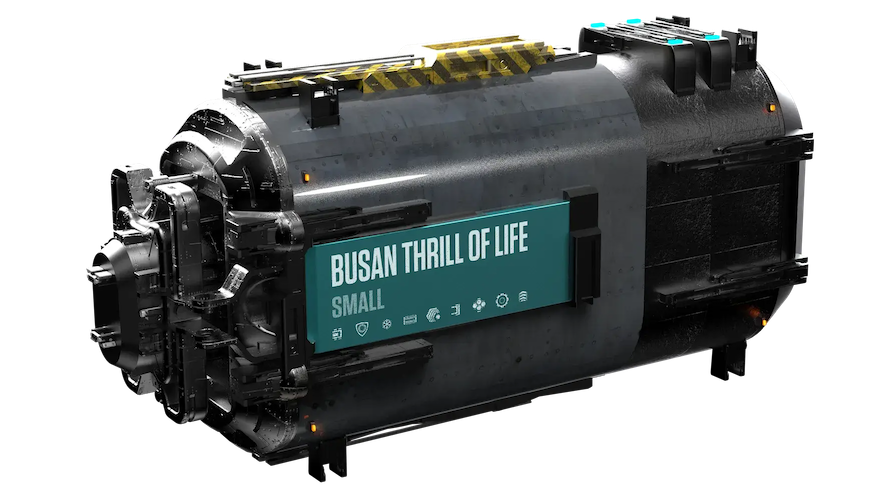
Star Atlas – Busan Thrill of Life Ship Parts Bundle
A Bundle of Ship Parts
For every ship you owned on August 8th, you should have received precisely one bundle. Like Crew packs, you will be able to open these bundles in the future to receive the parts inside.
A Ship Parts bundle contains weapons, modules, and (most often) higher-tier ship parts for a specific ship. The team published a table in a previously published article (well worth a read!) that lists which higher-tier ship parts are in each bundle. Note that it does not list weapons and modules. Those details can be found in the ship’s descriptions on the Marketplace.
Unlike Crew packs, the contents of two bundles with the same name (so, for the same ship) will be exactly the same. There is no random factor involved that will turn a component into a special variant. At least… for now. The team can always change things up between now and the opening of these packs.
Beyond the links in the text above, the Ship Configuration System article from September 2023 is another interesting read.
Frequent Questions Answered
- **Will There Be More Bundle Airdrops?
No. Ships acquired after the August 8 snapshot—whether purchased from the Marketplace, gifted by a friend, or crafted in-game—will NOT receive a Ship Parts Bundle airdrop. If the ship existed at the time of the snapshot, its previous owner would have received the bundle. In the future (likely before Ship Configuration goes live), you’ll be able to craft individual components instead. - Are Current Ship Stats Reflecting the Bundles?
The ship stats you see in SAGE/Fleet Command currently assume your ship has all components from the Ship Parts bundle equipped. Once ship configuration becomes possible, ships will revert to T0 components by default, resulting in lower stats (and no weapons) until upgraded.
Solana Issues & Blockchain Plans
Over the past few weeks, the community has had to frequently deal with Solana congestion and spiking priority fees. Complaints about these have easily drowned out every other potential issue the community has encountered recently. Many SAGE players have reached out to the team to ask them to find a way to combat this, even if this would mean leaving the Solana L1 blockchain.
This past Friday, Michael responded to these concerns in the Announcements channel of the Star Atlas Discord with the following statement (included in full):
Hi everyone,
In light of recent growing frustrations with the performance of SAGE Labs onchain mechanics, I wanted to take a moment to address here publicly some recurring community questions about any concerns we have as a team about the long term viability of “fully onchain gaming,” as well as communicate some of the possible solutions we are, and have been, considering. I’ll preface by emphasizing that there is no silver bullet, and that every potential solution comes with trade-offs. There is also no immediate solution we can implement. However, we have experienced these spikes in user activity on Solana in the past during periods of high volatility, and they tend to subside when things stabilize for a while, leading to better game performance and lower fees. But as we’ve seen Solana grow in popularity, there is no reason to expect we won’t face similar issues going forward.
So, for full clarity, I’m going to be focusing this post on two issues:
- Transaction Settlement Reliability: do the actions you take in game settle onchain? (on the first attempt!)
- Transaction Fee Impact: how much do you have to pay in SOL to play? (can users play profitably?)
In responding to these questions, I need to talk a little bit about why we’re even building game logic onchain in the first place, as well as the core ethos/philosophy of ATMTA in building Star Atlas. The entire concept of Star Atlas centers on this idea of a globally accessible, open, permissionless, and decentralized open world space adventure MMO (and metaverse integration). That’s a whole lot of crypto buzzwords, but it’s something I feel deeply passionate about (as does the team). If we’re truly going to accomplish building a cybernation with a self sustaining, global and borderless economy, managed by a new political system and set of rules (the DAO), Star Atlas needs to be censorship resistant. It can’t just run on ATMTA servers in the long run. And while it is going to take tremendous effort to accomplish that goal, building game logic via smart contracts (onchain programs) is arguably the first step towards decentralization of the Star Atlas universe.
There are other benefits to building onchain, such as composability and extensibility. This simply means that other developers, whether that be organized teams or individual contributors, can build out applications that integrate with Star Atlas seamlessly. Which is why we created https://build.staratlas.com/, to help facilitate this co-creation of Star Atlas. And we’ve seen a number of incredible applications come from it: SLY Tools, ATOM (up-and-coming), EveEye, Aephia dashboards, many others, and many more to come. And this extends to entrepreneurs leveraging the open Intellectual Property policy, enabling non-ATMTA companies to form and monetize products using Star Atlas IP (e.g. Galia Merchants). And finally, onchain logic in many ways makes our backend systems more secure and reliable. I’ll post a little excerpt here from Jacob, our co-founder and CTO, about some of these benefits:
It's hard to fully express how awesome it is from an engineering & security perspective having the fully on-chain game systems.  Many MMO projects struggle for years to solve problems that are solved for us by default by building fully on-chain, particularly related to data security & authorizing user actions.

-Jacob Floyd
In a nutshell, that’s the “why” we’re building our architecture the way that we are. And we have no intentions of changing that. We set out to build a world-changing MMO, and this blockchain integration is an integral part of that vision.
Which leads to the question of, what are we going to do to improve the user experience. Fortunately, this topic is something we have been considering for the better part of a year. Though it hasn’t really been a pressing or prioritized challenge to solve until more recently. And we do intend to future proof Star Atlas.
I’d also like to note here that the team has been working tirelessly on infrastructure improvements to ensure that transaction issues aren’t related to Star Atlas specifically. There’s still room to improve, but dramatic improvements have been made, and many more are in the process of being implemented (Starcomm v2, StarFrame, IronForge, etc.). Setting that aside for the moment, we need to solve for exogenous variables outside of our control (i.e. network congestion and priority fees).
There are several potential avenues ahead of us, including:
- Apollo (likely rebranding) / AtlasNet — ATMTA’s Solana clone/fork, which we’ve been leveraging for internal program testing
- SVM/L2 solutions
- MagicBlock
- Sonic
- Moving to a new layer 1
- Game logic changes to reduce transactions
I’m going to come back to Apollo. So, starting off with some of the SVM alternatives, I’ll note there are some interesting products out there. And there very well could be a short term implementation of one or several of these solutions. However, the downsides consist of additional reliance on third party solutions, as well as a general lack of true decentralization. Referring back to my comments about our core philosophy, it’s imperative to us that Star Atlas can operate long into the future, without the requirement for ATMTA to provide and maintain the infrastructure (years away).
Considering a new blockchain protocol, particularly for SAGE, lacks any real viability. Given the considerable number of programs we have already deployed, and inconsistencies or incompatibility with base language, data structures, and general code logic would imply a complete re-write of every one of the programs we’ve created for SAGE. Years of work. And realistically, we would be moving away from the blockchain that has already captured significant mindshare and market share, alongside the interest of countless developers that can be targeted to build applications supporting the Star Atlas ecosystem. Solana is also a network that has arguably been the most stress tested and battle hardened. Any other network achieving comparable levels of success would likely succumb to the same pitfalls, and challenges for our players, that Solana is presenting to us now. Sure, ATMTA could receive a substantial grant to transition, but it would set us back years. And again, we’re still moving away from a clear winner.
I’ve seen a number of requests to make changes to game logic to reduce the number of transactions, similar to what we did with SDU mechanics. On this, all I can say is that I’m strongly opposed to making changes to game design simply because we have a short term technology limitation or challenge. Gameplay is the cornerstone of Star Atlas. If we make the game terrible just to reduce costs, we’re never going to succeed. That’s not to say that we won’t make changes to game design over time, but I certainly do not want those decisions to be a result of protocol choice. The game needs to be fun, and needs to match what game design wants to see. Period.
Which finally leads us to Apollo. And to be honest, we weren’t prepared to fully reveal any details about it. Dan is currently working on the addendum I referenced during the year-end Town Hall, and details are soon to be released. Apollo in it’s most basic form, as it presently exists, is already functional. It’s a fully centralized layer 1 purpose-built for Star Atlas testing. Meaning it already runs the exact same programs that we deploy on Solana mainnet, just in a private version of Solana for us. The future of Apollo could very well be a fully decentralized network, synchronous with Solana, optimized for Star Atlas. We have a significant opportunity in front of us given we already have a decentralized organization generating cash flows from gameplay — the Star Atlas DAO. Meaning we have an avenue to compensate validators on Apollo.
Again, I don’t want to get in to specific roadmap details for Apollo in this post. And to be clear, a move in this direction would also mean years of work. But some of the potential benefits could include:
- Zero-fee network transactions for users
- Initially, zero network congestion, with the DAO given authority to permit new games/projects/programs later
- A network optimized for Star Atlas
- Validators compensated via the DAO (perhaps the first form of revenue distribution)
- POLIS locking requirements for validators
- Licensing/Node sales to validators
- State hashes secured on Solana, further hardening Apollo security and retaining the relationship with Solana
- Solana programs easily re-deployed on Apollo
To be clear, Apollo would not be an L2 rollup solution. It would be an independent, fully decentralized network, over time. But it would leverage one of the most performant blockchain protocol codebases in existence today, and be potentially security hardened by Solana’s network state.
This is the absolute TLDR version of what Apollo could become. More from us in the near future. But I wanted to reassure everyone that we are thinking about these issues. We do want a positive gaming experience for everyone in Star Atlas today, and all of the future players/creators/builders/entrepreneurs we see joining. And at the risk of sounding repetitive, you all are participating in the bleeding edge of innovation. Which means we’re going to hit some bumps in the road. But we’re going to overcome any obstacle in our way, and we’re going to make this thing a reality.
Power to the People.
During the town hall held last December, Michael briefly mentioned that two papers were being worked on, which would be addendums to the current White Paper and Economic Paper. One of these will focus on the Atlas Locker, while the other one “centers around the future of Star Atlas network connectivity and kind of ties into POLIS”, to use Michael’s words. Dan (Legal Council) is currently working on it, and this is the one that Michael is referring to in his above statement.
It looks like we’ll hear more about Apollo and plans to mitigate the “exogenous variables outside of our control” upon publication of that paper.
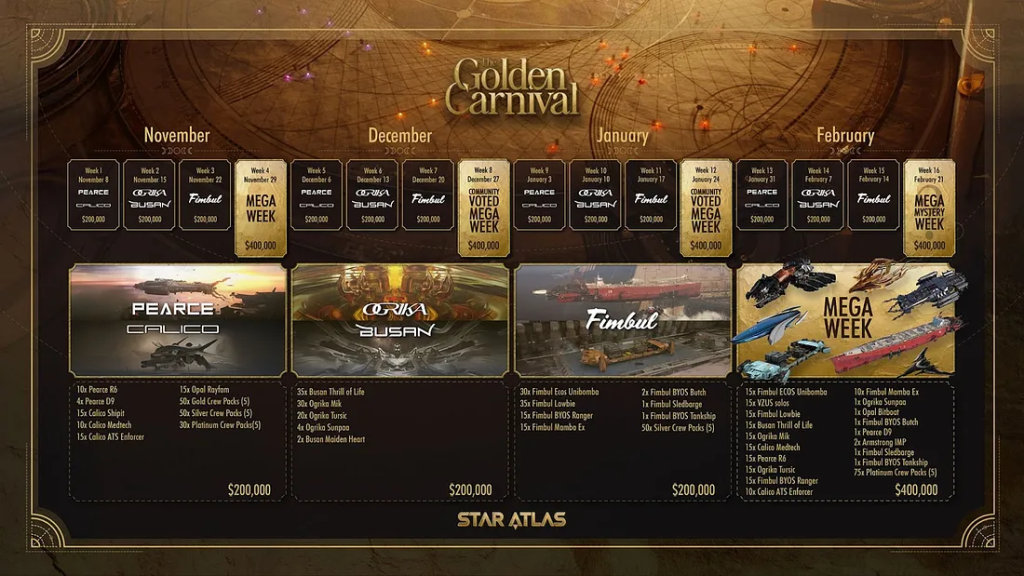
Star Atlas – Golden Carnival 2024 – Schedule
Golden Carnival
Though the team took a two-week break, the Golden Carnival did not skip a beat. That means that by now, three additional drawings have taken place, with the first being another Mega Week drawing taking place right after Christmas.
Let’s briefly go over the stats:
- Week 8 – Mega Week
The second Mega Week (Dec 21 – Dec 27) saw 4,293,829 tickets submitted and 185 prizes distributed. - Week 9 – Pearce & Calico
The 3rd Pearce & Calico week (Dec 28 – Jan 3) saw 1,949,695 tickets submitted and 199 prizes distributed. - Week 10 – Ogrika & Busan
The 3rd Ogrika & Busan week (Jan 3 – Jan 10) saw 1,828,170 tickets submitted and 91 prizes distributed.
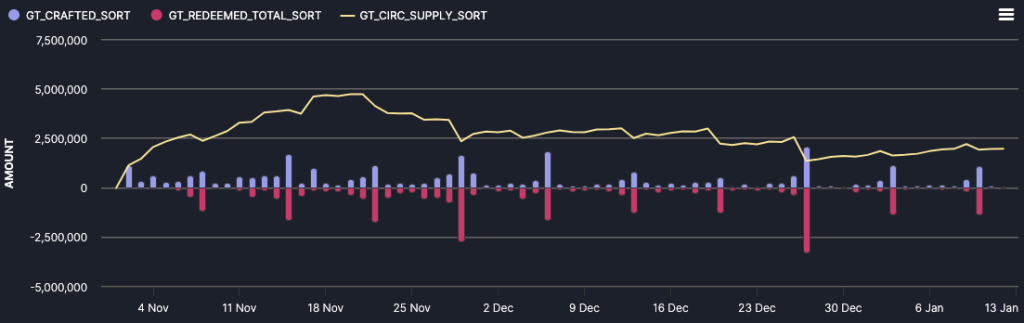
Golden Tickets crafted, created, and submitted [by Aephia’s Data Runners]
Compared to the first 4 weeks, the above graph shows that Carnival participants have started saving up their tickets for the Mega Week instead of submitting them on the intermediate drawings. In addition, the total number of Golden Tickets available within the ecosystem has been trending down since week 2. It will be interesting to see how the last 5 weeks will unfold!
Ticket submission for Week 11, another Fimbul-sponsored raffle, has opened up! This week comes with a short and snappy lore-snippet intro:
The eleventh cycle of the Golden Carnival blazes onward, where destiny and daring intertwine beneath the stars.
2024 in Review
If you missed the special “2024 Summarized Through Newsletter Headlines” article we sent out right after Christmas, it’s well worth a read! We review the whole of 2024 and summarize the releases, shows, and other interesting highlights from the past year.
That’s it! You’ve reached the end of the first newsletter of the new year!
Happy New Year from Aephia Industries!