Welcome to our 163rd newsletter on Star Atlas! This weekly newsletter, published by Aephia Industries, focuses entirely on the development of this ambitious game. Here, we try to aggregate all the newsworthy tidbits revealed [mainly by the team] throughout the past week.
The second week of the year is behind us, marking the fourth anniversary of Star Atlas’ public unveiling! On January 15th, 2021, the team launched their Discord server and published their first Medium article, which introduced the project and linked to their White Paper.
This past week brought an Economic Forum and a Brew with Michael (CEO), delivering a wealth of updates and clarifications. The biggest news? A major bundle of economic changes is set to roll out in SAGE this coming week. Additionally, Never Alone is wrapping up, and we gained key insights into upcoming Solana improvements and Apollo’s roadmap.
Let’s dive right in!
![Star Atlas - Fleet Command [WIP]](https://assets.aephia.com/wp-assets/5f6e687b877ef5eb5f9aca8753d22567d33c3fdc60bc85467d7773dead55c8d1.jpg)
Star Atlas – Fleet Command [WIP]
SAGE Updates Imminent
This Thursday, 0:00 UTC, the team plans to roll out several economic changes to SAGE. Below, we go over all three changes.
SDU Upgrade Timer
Currently, it takes 1 second per SDU to install SDUs at a Starbase (upgrade). This means that players can easily dump many of these very close to the end of an epoch, making it difficult for other players to even somewhat predict the potential outcome of the day’s ATLAS to LP ratio.
The Econ team will substantially increase the install time, though they refrained from sharing what number they have in mind. We’ll find out when this change goes live!
FIC Recipe #2
New Faction Infrastructure Contract recipes are coming to SAGE! Every Faction gets a second FIC recipe that will be more complicated to craft and come with a different ATLAS redemption value.
Chris (VP of Economy) mentioned that SDUs will also be required in this recipe, but proportionally, they will make up less of the total pool of ingredients.
Just as with the current FIC, redemption will be available at (up to — see below) 2 Starbases simultaneously. These 2 Starbases are randomly picked from the same 6 locations that the current FIC buy-orders can spawn. This could result in buy-orders for both the new FIC and the existing FIC being available at the very same Starbase every now and then.
FIC Redemption Change
Another change that will be coming this week is that the team is not going to refill FIC buy orders as long as there is still a buy order left on another Starbase.
In effect, this means that redemption of a FIC type will be available at, at most, 2 Starbases, but possibly only 1 Starbase. If the orders run out on both Starbases, the team will refill both of them. The amount of redemptions is still meant to be unlimited!
This will incentivize players to move around more and use the Local Markets to trade their FIC if the trip is too costly.
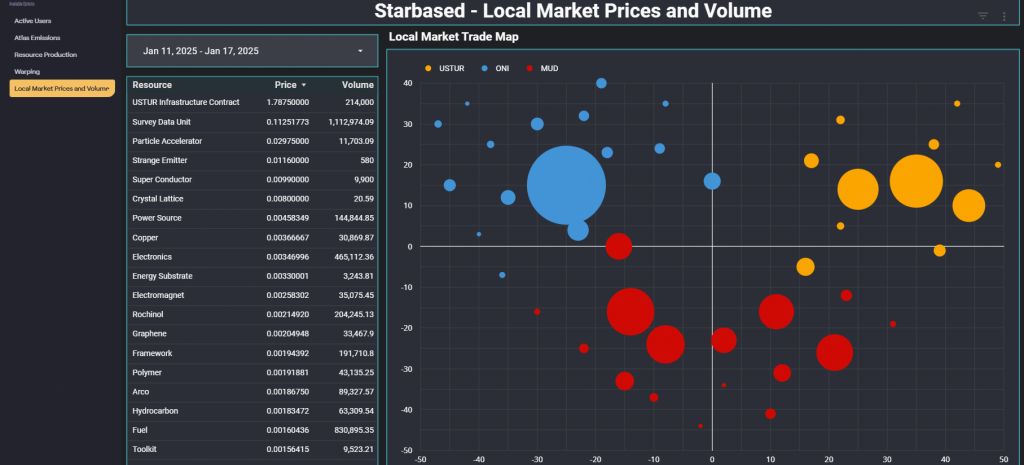
Start Atlas – Economic Dashboard – Local Market Sales
Economic Forum
Beyond the SAGE updates mentioned above, the 8th edition of the Economic Forum came with some other interesting tidbits from the econ team.
First off, the Econ team updated their dashboard. They added a view that shows local market trades that took place in the different star systems. You can select a resource and a date range, which will plot the data on the map. The bubble size shown on the map depicts the number of trades that took place there within the date range.
Beyond this significant new update, they also provided polish to the existing dashboards.
Soon, the dashboard will move out of the “broom closet” (Chris’ words). At present, it is hard to find because it’s hidden in the More section of the governance website. The plan is to move the link to the governance front page instead.
Lastly, Chris highlighted that they saw a daily average of $20k in resource trades over the past month. These are only the resources, so these are all gameplay-related trades!
There were, of course, other tidbits shared during the forum, so definitely check out the recording if you want to stay fully up to speed on the Economics!
Solana & Apollo
Last week, Michael joined the Atlas Brew to discuss the statement he had shared the week prior. He was joined on stage by Brett (VP of Engineering) and Bryan (community member & Solana validator), who provided additional insights into the technical aspects.
Michael began by acknowledging that his statement was a bit premature, but he felt it was important to address community concerns about Solana congestion and fee pricing. More details are on the way!
Next, he emphasized that Apollo is just one potential solution the team is considering—it’s not a guaranteed path. His preference remains staying on Solana.
The team has been putting in significant infrastructure work to improve transaction settlement reliability. More optimizations are coming, and while there’s still work to be done, Michael expressed satisfaction with the progress so far.
He also reiterated his surprise at how transaction costs have evolved. In the early days, he praised Solana’s sub-one-penny fees, but now, some transactions can cost up to 10 cents. While that might be fine for standard DeFi transactions, it doesn’t work for the game’s zero-to-hero journey—which is something the team wants to realize. It’s a problem that needs to be solved.
Michael joined the Atlas Brew last week to talk about the statement he shared the week prior. In addition, Brett (VP of Engineering) and Bryan (Community member & Solana validator) were present on stage as well to provide additional color to technical aspects.
Then Bryan chimed in with details on the many improvements coming to Solana and what various teams are working on at the moment. He went into developments such as RPC 2.0, Solana 2.1, Frankendancer, Firedancer, Double Zero, expansion of Compute Units, and Timely Vote Credits (TVC).
Going into things the team can do, Michael shared that the upcoming ATLAS Locker addendum will contain a proposal for an on-chain fee subsidy paid for by the DAO. This subsidy will be dependent on the tier of the locker reached.
Toward the end, Michael went into how Apollo nodes could generate additional revenue for both ATMTA and the DAO. Selling nodes is popular in Web3, but most are only superficial in what they contribute to the protocol. For Apollo, things would be different as these nodes would be the actual validators.
Having nodes, more specifically, selling nodes, could offer some interesting benefits:
- Currently, the team relies on asset sales, marketplace fees, and token sales to fund their operations. The team could start selling node licenses on top, which would be required to run a validator for Apollo. This would generate revenue for ATMTA, which they need to develop the game. This extra stream could help the team reach their funding goals earlier, allowing them to rotate revenue from new asset sales to the DAO. This would result in the DAO generating income from asset sales as well.
- A second part of this is overcoming regulatory compliance concerning revenue distribution. It’s difficult to legally distribute DAO revenue to POLIS stakers, as that has every appearance of being a security. However, with a POLIS Locker requirement and the license, the validator is now providing decentralization as a service to the DAO. It is completely reasonable for the DAO to say we are going to compensate you for providing that service. It could take a portion of its revenue and distribute that out to the validators. As an end-user, you would delegate your POLIS stake to one of the validators, and the validator could then decide how to compensate you for the stake provided to them, much like how Solana staking with validators works.
Lastly, Michael briefly addressed community concerns regarding the cost of running a validator. He shared that the team is spending up to 1000 dollars/month on their 6 Apollo validator nodes and 1 RPC node. In other words, they are spending less than $150/month on a single Apollo validator.
All in all, it was a very interesting and educational Brew! If some blockchain-related technical terms do not scare you, we recommend you check out the recording.
Never Alone Wrapping Up
During the Atlas Brew, Santi (Director of Community & Ecosystem) announced Never Alone quests would be removed on January 22nd, marking the end of the Never Alone campaign.
There are still some quests available if you want to try to get some Mission 3 memories.
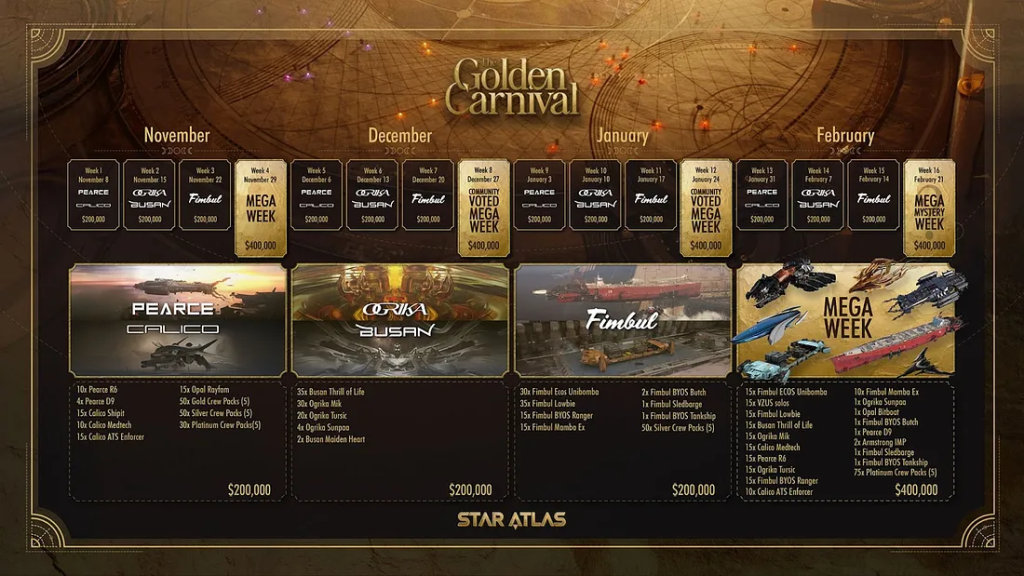
Star Atlas – Golden Carnival 2024 – Schedule
Golden Carnival
The 11th drawing took place this past Friday, which was another Fimbul-sponsored week! In total, people submitted 2,150,896 tickets, which earned them 149 prizes in total!
The community team hosts a stream every Friday during the Golden Carnival drawings. During the previous one, the community was asked to vote on the prize pool for the 3rd Mega Week, which has meanwhile kicked off.
This is the list of prizes that was settled on:
- 5x Fimbul Sledbarge
- 7x Fimbul BYOS Butch
- 4x Armstrong IMP
- 22x Calico ATS Enforcer
- 24x Fimbul BYOS Ranger
- 5x Calico Medtech
- 23x Calico Shipit
- 17x Opal Rayfam
- 20x Platinum 5 Crew Pack
You can submit your tickets today if you want to participate in this Mega Week! Close to 600k tickets were already put in at the time of writing this.
You’ve reached the end of this week’s issue! Thanks for reading!