Welcome to our 176th newsletter on Star Atlas! This weekly newsletter, published by Aephia Industries, focuses entirely on the development of this ambitious game. Here, we try to aggregate all the newsworthy tidbits revealed [mainly by the team] throughout the past week.
This past week in Star Atlas was relatively calm—no major releases, interviews, or surprise alpha drops from the team. However, we did see a small but meaningful update to the fleet rentals UI, featuring a long-awaited overhaul of the scoring system. Meanwhile, the DAO has three active PIPs open for voting, so make sure your voice is heard. We’ve also included a few smaller updates at the end that are still worth checking out!
Let’s dive in!
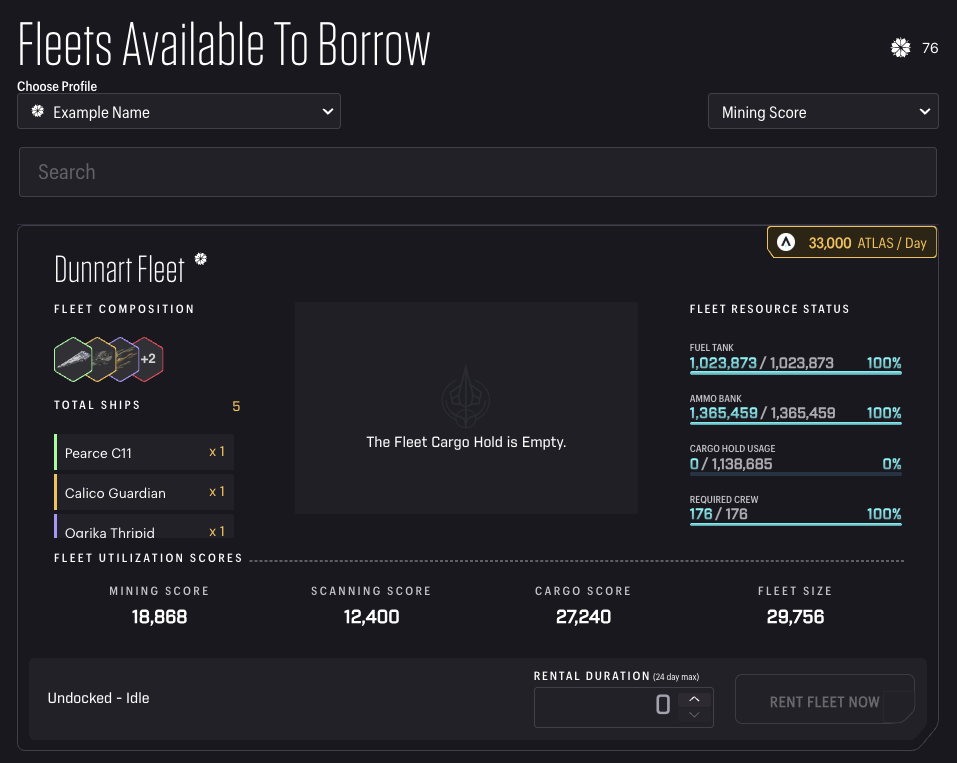
Star Atlas – Fleet Rentals – Updated UI with new Scoring system
Fleet Rentals Update
The team rolled out an update to the Fleet Rental page, re-introducing the search bar functionality and replacing the fleet scoring system. With these new scores, the user interface now also offers an option to filter by them. Additionally, the UI displays an “Approximate Market Rate” indicator when listing a fleet for rental, helping players set a competitive price.
Fleet Scores
Here are the four new fleet scores, as presented by the team:
- Fleet Size – Measures the total scale of the fleet; larger fleets tend to command better scores and higher rental fees.
- Mining Score – Calculates your fleet’s resource extraction potential based on six key traits. The higher the score, the better your fleet is at mining.
- Scanning Score – Determines your fleet’s ability to scan using seven scan traits. The higher the score, the better your fleet is at scanning.
- Cargo Score – Assesses your fleet’s hauling capacity across five core cargo traits. The higher the score, the higher your hauling capacity.
If you would like to know the underlying formulas or gain a deeper understanding of the rationale behind these, the Economic team has published a technical paper that provides both.
DAO Updates
There are three PIPs open for voting at the moment. If you haven’t checked these out, you can read our short summaries below. If you have POLIS locked, remember to cast your vote and make your voice heard!
PIP-12: Iris’s Bounty: The Feast — This proposal introduces “Iris’s Bounty: The Feast,” a program designed to allow Star Atlas community members to apply for funding from the Star Atlas Ecosystem Fund to host small-scale social events. These events aim to strengthen the community and foster deeper connections among players. The program allocates $10,000 of Atlas from the Star Atlas Ecosystem Fund, with a maximum of $500 per request. Applicants will be required to provide event details, expected attendance, and estimated costs to receive funding, streamlining the process compared to drafting a full PIP.
Results around time of publication: 58% For, 24% Against, 18% Abstain Closes: Sunday, April 27th, end-of-day UTC
PIP-13: Implementing Term Limits for Star Atlas DAO Council Members — This proposal establishes term limits for Star Atlas Council members to ensure fair turnover, prevent governance stagnation, and encourage fresh perspectives in DAO decision-making. It updates the existing election framework by introducing a two-term limit, after which a Council member must sit out at least one full term before running again. This is accomplished by replacing Section 4.4, “Term Limits,” of PIP-10 (Star Atlas: Council: Second Term & Beyond) with a new set of term limit rules outlined in Section 4.2. This proposal ensures that governance remains dynamic, decentralized, and resistant to entrenched influence, aligning with the DAO’s principles of transparency and equitable representation.
Results around time of publication: 38% For, 58% Against, 4% Abstain Closes: Monday, April 28th, end-of-day UTC
PIP-14: Deepening THEO Integration into the Star Atlas Economy — This proposal requests 10,000 USDC as a one-time development cost for a focused, fixed-term 6-week project aimed at enhancing Star Atlas’s economic ecosystem. In simple terms, we’re asking for 10,000 USDC for a 6-week effort to upgrade THEO with better economic tools, prepare it to connect with Star Atlas systems, make it smarter using DAO knowledge, delivering an improved web version immediately and a package for potential future in-game integration, with a commitment to repay the grant from initial fees.
Results around time of publication: 90% For, 10% Against, 0% Abstain Closes: Wednesday, April 30th, end-of-day UTC
News Bits
To wrap up this week’s issue, we have a few short tidbits:
- The team rebased the ATLAS side of their Marketplace offerings to the USDC price this past Wednesday. This result is that ATLAS prices have increased, and the steep discounts are no longer available. The team does this occasionally when the ATLAS price (in USD) deviates significantly from the USD value of the assets they offer.
- Danny (CPO) shared that the team is exploring the addition of melee weapons to the game, specifically the Energy Swords featured in the CORE graphic novel.
- Female Ustur body types will be available in a future set of crew packs.
- Gary Sanchez (Vehicle Art Director) shared that the team finished work on 16 XXS/XS-sized ships, of which two remain unrevealed and one has not yet been released (the Busan Eyes for a Moment – XS Fighter). The Tufa Spark is currently in progress.
Lastly, Michael (CEO) responded to a question from the community in the Foundation Room:
Q: Of the engineers working on SAGE/Economy, roughly what percentage is dedicated to alleviating pain points in the current version of SAGE/Econ [vs the percentage dedicated to working on C4 and other roadmap items]?
Michael: Well, we have a team of 3 working full time on Starcomm, so in a way, those are QOL improvements. Some of their work has to do with existing SAGE, but largely they’re working on improvements that will impact both the current version, and the C4 rollout. Otherwise, tbh, the whole team is primarily focused on future-feature development. But we are fielding support tickets, and those get distributed out to various engineers to tackle. Though those efforts are generally lower priority than building what’s next. I appreciate that maintenance is important, as we have a live product, but the live product isn’t necessarily driving growth, so establishing a feature set that enables us to scale takes priority from my perspective.
You’ve reached the end of this week’s issue! See you again next week!