Welcome to our 216th newsletter on Star Atlas! This weekly newsletter, published by Aephia Industries, focuses entirely on the development of this ambitious game. Here, we attempt to aggregate all the newsworthy tidbits revealed, primarily by the team, throughout the past week.
This week’s issue leans heavily toward economics and governance. The newly selected Econ Vantarah group has already begun its work, the latest Economic Forum introduced several upcoming adjustments to OMO pricing and crafting plans, and DAO voting delivered a clear outcome on PIP-26. Alongside that, Michael shared candid updates on release progress, team morale, and the financial realities behind recent decisions.
Let’s dive in!
Econ Vantarah
The Econ Vantarah members have been selected by Chris (VP of Game Economy). This group of seven community members will join the discussion about the future of the Star Atlas Economy:
- 《VΛ》| Tango⪛⦿⫺Z.ike
- 《VΛ》 KATIR
- 𝐑𝐎𝐌𝐄 | Virtuwul
- [AEP] Viktor
- [Λ] Neo_AArmstrong [EC]
- [SLY] anthonyra
- [AEP] Lerinor
Chris shared that he kept the group small to keep the conversation concise and efficient. He also wanted a very diverse group, with different opinions. He went over all submissions one by one and carefully read their answers. During the Econ Forum, Chris suggested that perhaps some well-known people may have relied a bit too much on their reputation and did not take the questions seriously enough.
The current idea is to cycle the group (or at least some members) every 6 months. Chris wants to prevent stagnation and hear new ideas.
After the group selection finished, the group immediately began working on the Mamba EX buy orders.
Lastly, there will be a new monthly event, held every 2 weeks after the Economic Forum, where Econ Vantarah members will interact with the wider community. The goal is for this to be more Vantarah-led, with Chris in the background.
Economic Forum
Chris kicked off February’s Economic Forum by sharing that players had found a way to still use the Buddylink referral system when acquiring ships from the team. This means many folks likely managed to buy ships from the team at much lower cost than was intended. For that reason, and given that no OMO assets were sold (by the team) over the past two weeks, prices across the board will likely be lowered for the current tranche of OMO assets. Chris
In other news, the team is going to add 75 Mamba EX buy orders for (likely) around ~$100 in ATLAS value. The ATLAS will come from the ATLAS emissions curve. Good to know: these orders will be listed for sale by the DAO, not by the team. The plan is to publish an announcement roughly 24-hours before these orders go live.
The crafting recipes for Mamba EX and Calico Maxhog will be tweaked further down. They are currently still too high to be enticing to players. Chris’ plan for the new recipe is to include FICs (Faction Infrastructure Contracts) in them to give those assets another purpose. By pulling FICS out of circulation, ATLAS emissions will be lowered (but that will be offset by the Mamba EX buy orders). This change will likely go live with the Mamba EX buy orders.
A last interesting tidbit from the Econ Forum was that resource production speeds will likely be lower in C4 than they are today in SAGE Starbased.
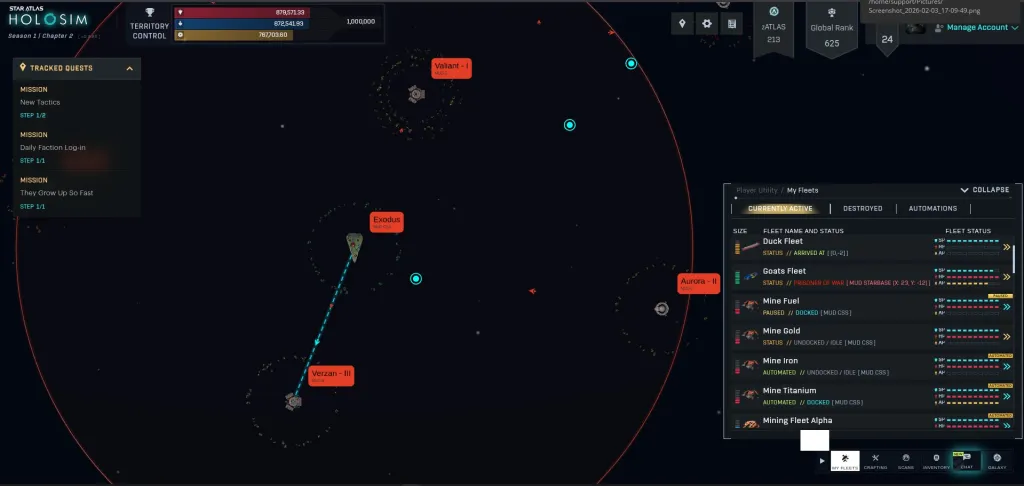
Holosim – Season 1 – Chapter 2 [preview]
DAO Updates
The voting period for PIP-26 has come to an end, with the end result being a rejection by the majority of the votes. Below, we’ll repeat the PIP and include the final voting stats.
PIP-26: Star Atlas Crew Adventure Series – Season Production
The Star Atlas Crew Adventure Series is an ongoing cinematic storytelling project that produces AI content rooted directly in Star Atlas lore. This proposal funds the production of one complete season, consisting of:
- 2 months of weekly episodes (4 minutes or longer each).
- 3 weekly YouTube Shorts tied to each episode.
The request of 13,143,639 ATLAS covers the entire content pipeline: writing, worldbuilding, environment creation, character development, animation, sound design, original music, editing, and distribution on YouTube and X.
Earlier seasons (1–3) are already publicly released, demonstrating both capability and viewer interest. This proposal provides the resources for the next season, allowing the series to continue expanding the Star Atlas universe and offering consistent, lore-driven media that can attract new participants to the ecosystem.
See https://www.youtube.com/@StarAtlasCrewAdventures for the existing seasons.
- Requested funding: 13,143,639 ATLAS (max allocation from Ecosystem Fund)
- Structure: 1-off PIP
- Author: Hammerhead
Final results (~167M PVP committed):
- For: 30.42%
- Against: 52.59%
- Abstain: 16.99%
In other PIP-related news, Jose’s proposal has meanwhile moved on to the draft stage.
From The CEO
Over the past two weeks, Michael has answered many questions in the Foundation Room. When asked about the progress made on the upcoming few releases, Michael shared the following:
- Holosim – 98%
- C4 PTR – 90%
- z.ink – 60%
He also added that Z.ink Mainnet won’t be ready in March.
But that was not all. Below, we are pasting some of the more interesting things he shared.
Asked about other salaries for team members and the team’s mood:
We also have salary reductions across the team. A handful of people on the team (me) are taking peanuts.
[…]
Most of our team is significantly underpaid, if we look at the competitive landscape. The only reason we retain talent is because they love the vision of what we’re building
[…]
Everyone, so far as I can tell, is still highly motivated and excited about the upcoming releases. I’m sure there’s a shock factor from the recent reductions, but all of the meetings I’m on are positive.
Being asked about cost savings and the move away from StarComm V2 to RPC:
There were two reasons for switching to direct-to-RPC:
– Solved a big pain point in user experience by eliminating a system that caused a lot of bugs, and generated a lot of support tickets.
– Reducing infrastructure costs. “Huge” is a relative statement, but it did cut our infrastructure costs considerably.
That said, payroll is our largest expense group by far. There aren’t really any opportunities to significantly reduce spend on services + infrastructure + ops because salaries are probably 90% of our spend.
In terms of costs to operate C4, I would say they’re going to be comparable to SAGE, and will modestly scale WHEN we get 10’s of thousands of players there. We don’t pay validators to operate. Token emissions and tx fees (technically users) pay validators. Just like you guys pay SOL fees to validators on Solana. The fees that you pay on z.ink in dollar terms will be lower because of FDV.
Lastly, a more philosophical overview of the current situation:
[…] our funding model is very much founded in crowdfunding. It’s a model that has worked well for Star Citizen, with their revenues nearing or exceeding $1B over the years they’ve been in dev. We certainly have some unique challenges (and value propositions) that they don’t. The secondary market is a prime example of that. We have to compete with owners for sales. But that same feature drives benefits and value for players. Market sentiment has also overshadowed our development because of the nature of our real cash economy and depressed financial incentives. Nevertheless, our long term success has always required that we build an attractive product to use, both from the gameplay (entertainment factor), and the financial layer.
Our predominant cash flows right now come from token sales (unfortunately). Longer term, our strategy was to transition into fee generation from the marketplace as a primary revenue source. But with depressed DAU and tx volume (and people circumventing our fee), those are quite low at the moment. This can rapidly shift if a strong product release drives growth. We also pick up royalty fees on Tensor trades of crew, though also small right now.
Moving forward, we are creating new opportunities with the launch of z.ink, via emissions as a validator, and the potential to TGE some of those tokens. Not really my preferred option, but it is an option. Additionally, we’ve circulated some details of a Token Validator license deal with some potential interest floating around. However, I really don’t want to rely on token sales as the funding source. It’s perceived negatively, has at least some impact on price (even when done strategically like we do now), is subject to volatility, and is not an infinite source. The primary strategy is to leverage hype in the airdrop to drive Star Atlas activity, and in turn drive revenue. z.ink has other potential revenue sources through .ink onchain namespace sales, and platform fees we can pick up from the digital identity side.
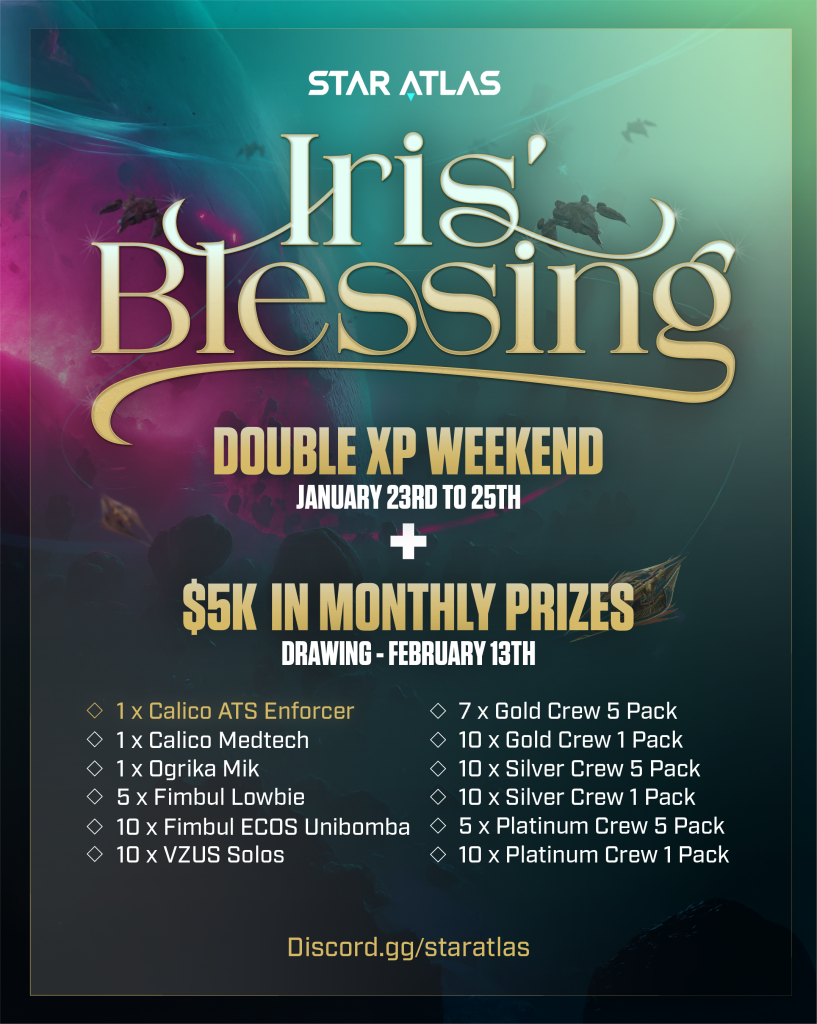
Iris’ Blessing Month 4
News Bits
To wrap this issue up, we have a few final bits of news:
- The 4th Iris’ Blessing raffle will take place this Friday, during the first Galia Game Night (18:00 UTC)
- Michael shared in the Foundation Room that the team will extend the Iris’ Blessing campaign with a second season.
- The team is officially closing Holosim Season 1 – Chapter 1 on Monday, February 9th (the date of this newsletter’s publication). This means that, starting on February 10th, they can begin setting up for Chapter 2!
- Last Wednesday’s Atlas Brew was all about Super Phoenix Sports. They went into their organization, upcoming tournaments, and prediction markets/betting. If this sounds interesting, make sure to check out the StarAtlasTV recording.
That is it for this week! Thanks for reading, and until the next!