Welcome to our 31st newsletter on Star Atlas! This is a weekly newsletter, published by Aephia Industries, that is focused entirely on Star Atlas . Here we try to aggregate all the newsworthy tidbits that were dropped by the team throughout the past week.
Team Retreat
Last week, the team’s retreat came to an end, with team members coming slowly back online during the second half of the week.
Ships
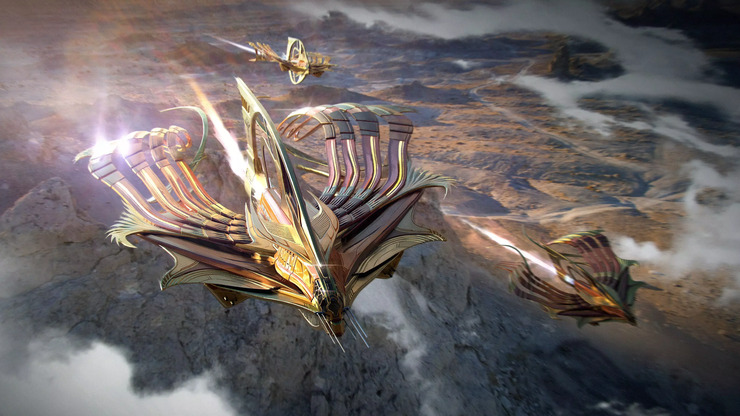
Last Friday, the team added the Ogrika Tursic to their marketplace. This marks the fourth Ogrika ship to have been released and the first medium one. Like the other ships from this manufacturer, it looks decidedly alien!
SCREAM
Chip (Director of Game Systems Design) answered some questions regarding SCREAM this week, shedding more light on what to expect. This section contains a small compilation of his answers.
First, Chip confirmed that all ships in SCREAM will have unique stats that are a function of the ship’s loadout, form factor, role, and manufacturer. Loadout here covers both the components and modules that are listed in each ship’s description.
He also mentioned that most assets in the game will be tradeable while there will also be a few that are account-locked (non-tradeable), such as blueprints and loyalty points (LPs).
Though combat is a large focus of SCREAM, support class ships will have an instrumental role in sustaining starbases and planets. These types of ships are more efficient at those jobs than fighters, which will be reflected in their LP earnings for that assignment.
On the topic of freighters, they will be able to move cargo most efficiently and this will be a necessary activity to support players’ R4 needs and get crafted resources to their desired locations.
Another interesting bit of info is that ships can repair and refuel anytime assuming toolkits and fuel are present. Refuel/Repair specialized ships have perks when doing so compared to other ship classes. Note that toolkits and fuel consume cargo space which makes refuel and repair class ships, specifically the Pearce R6 and R8 relevant and useful. Peer-2-Peer refuelling/repairing however is a stretch goal for V0 at the moment. It could very well end up in a later iteration of SCREAM instead.
On the topic of active/passive play styles Chip once again reassured that people playing actively all day will earn more LP/ATLAS than those playing passively. There will be opportunities for more passive playstyles, though these won’t be close to being as passive as is currently the case with SCORE. You won’t be able to walk away for several days and continue to earn. If/when lending becomes available, that will likely change.
Lastly, when asked about what will influence earnings in SCREAM, Chip stated that is very hard to answer, but he nonetheless tried to make it clear what factors play a role in this, by sharing a non-exhaustive list:
- Ships owned in SCREAM (requiring hangars)
- XP rank
- How you are spending your LPs
- How efficiently you play
- How much time you put in
- Playstyle
- How much territory your faction occupies
- R4 pricing and consumption
- Combat performance
- Player population
Progress
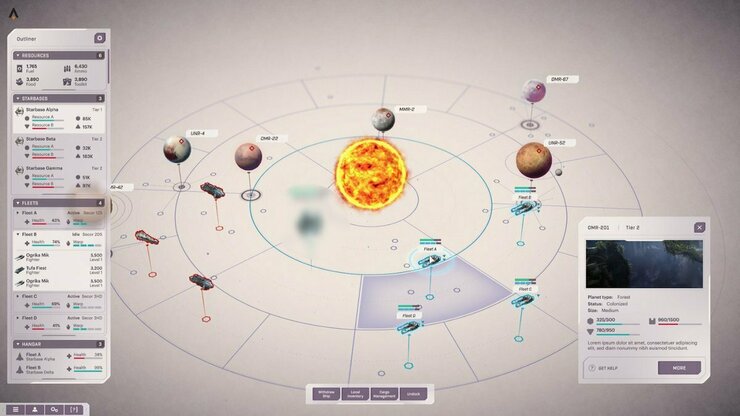
The progress report for SCREAM showed almost no changes when compared to two weeks ago, so there is really little to report. The only new tidbits that were new:
- Blockchain team has started prototyping “ship movement” and “star system” programs
- UI team has been working on the hangar screens
- The web team has been adding more depth to the starbase upgrading process
Galactic Marketplace
There is little to report in terms of progress. The UX team is continuing to work to support their front-end team, who itself has completed the bookmarks tab and sidebar filtering. This week they are working on update the buy and sell workflows.
Showroom
Danny (CPO) let slip that the full release of the showroom is internally targeted for October 2022. Though we do know that the showroom will be released in stages, it’s a little unclear whether or not to expect releases prior to that date. What is clear is that the team is certain that there will be two ships present upon this full release - the VZUS Opod and the Pearce X4. Additional ships will be added afterwards, as soon as their full production cycle has been completed.
Progress
The art team is finalizing the environment art. The expectation is that they will finish that this week.
The UI/UX team has been working with engineers to implement all logic and support for all visuals. This week they will focus on wallet-related tasks and splash screen delivery.
The Core Gameplay department has been investigating how to distribute updates to the game client to the users in the future. This week they are working on supporting all windows, bug fixing, and player game build delivery.
POLIS DAO
Staking Mechanics
Michael (CEO) clarified that when POLIS is staked, it will leave the user’s wallet. Only when staking POLIS will you be able to participate in proposal making and voting. The contract uses a Curve mechanism to determine the voting weight, but a proxy token is not issued - it is all managed on-chain. Voting weight is determined by formulate based on staked balance and duration of stake.
Furthermore, staking emissions (rewards) will be claimable based on the periodic epoch (not finalized yet, but probably 1 or 3 days). Those emissions will need to be claimed and staked for it to be considered in a player’s staked balance and voting weight. Claiming when an epoch ends will not be required, but when doing so (and re-staking) will maximize compounding. Otherwise, the balance simply continues to accrue and can be claimed up to the latest epoch in a single transaction.
Going deeper into voting weight, Michael mentioned that, as the team decided to implement the Tribeca/Saber suite of programs for the DAO, the voting weight curve perpetually decays through time unless players are manually increasing their stake duration. Players can easily extend the duration, but can never reduce it. The rationale is that there is a desire to have active engagement and participation in proposals and votes, and requiring more active management of voting stake would result in greater voter participation. The DAO isn’t intended to be a passive vessel.
As for the rewards, there are several considerations for the team:
- The frequency with which they can analyze chain data, given the assumption of a large number of staked accounts.
- Inherent cost to users to establish token accounts for token data
- Shorter epoch frequency provides maximum compounding opportunities to users, but at the potential cost of establishing more underlying token rent accounts to manage wallet data.
Lastly, Michael stressed that the proposition of DAO participation is about influencing the ecosystem, not about incentives or subsidies. The primary motivator for staking your POLIS should be the desire to be an activist within the SA ecosystem
Team Staking
On the team’s plans for staking their own POLIS allocation, Michael shared he is almost decided on the staking duration. Most likely the team’s POLIS will be divided over 3 different locking periods, being the 3-, 4-, and 5-year ones.
In-game POLIS DAOs
As for faction/regional POLIS DAO staking, Michael admitted that they did not yet consider how players will be able to stake their POLIS to their respective faction/regional DAOs. So it remains unclear if POLIS staked to the Star Atlas DAO, will be able to be allocated to the in-game DAOs, or if this needs to be staked directly into different contracts. He did add that it will most likely take at least a year before they get to the in-game DAOs, however.
Progress
The team reported that the product design has been finalized. The UX department completed the last refinements to the high-definition design and is now locking it down. Meanwhile, the Front-end team onboarded additional manpower for Web3/UX while continuing to convert the designs into actual web pages.
On the blockchain end, the team reported that the audit scope has been completed and that “other audit-related tasks” are ongoing.
COPA
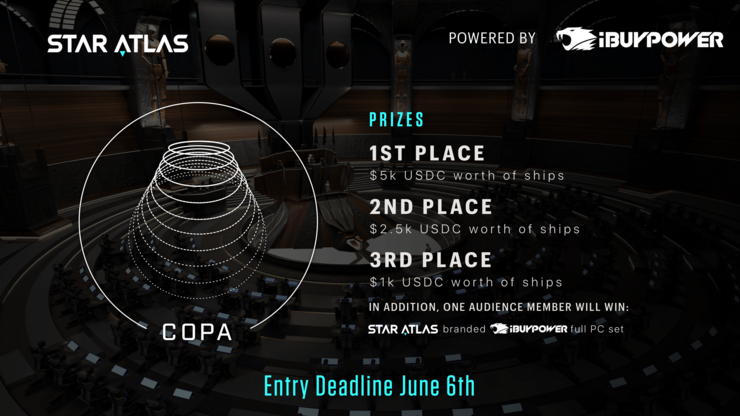
June 6th marked the last day guilds could submit their pitch decks to enter into the COPA competition. Based on the latest information from the team, the judges will select 10-12 guilds that will be allowed to pitch for roughly 10 minutes on stage during the COPA event on the 16th of June. After each pitch, there will be roughly 5 minutes during which questions can be asked by both the judges and the audience.
All guilds that submitted their decks are guaranteed a 1-on-1 session with the RevOps team of ATMTA Inc.